Mitos / The Thread of Greece

Mitos / The Thread of Greece
is a registered trademark.
Mitos – The Thread of Greece is a long-term photographic project exploring female identity as a carrier of memory, roles, and ritual in contemporary Greece.
Started in 2019, the project is based on staged portraits of women and girls positioned between private and public spaces – the home, the landscape, and the community. Traditional garments are not approached as folklore or museum artifacts, but as active symbols that carry weight, protection, and continuity. Worn on bodies that inhabit the present, they reveal how tradition survives not as a static past, but as a living process.
Mitos investigates the silent transmission of tradition from one generation to the next, through the body, the gaze, and everyday gesture. The “thread” becomes a metaphorical link between women and their history, binding personal experience with collective memory, and keeping these identities present within a world in constant transformation.
“THE INDEPENDENT PHOTOGRAPHER”
Mitos, the ongoing series by Greek photographer Michael Pappas, is a compelling ethnographic tribute to the time-honored customs of his homeland.
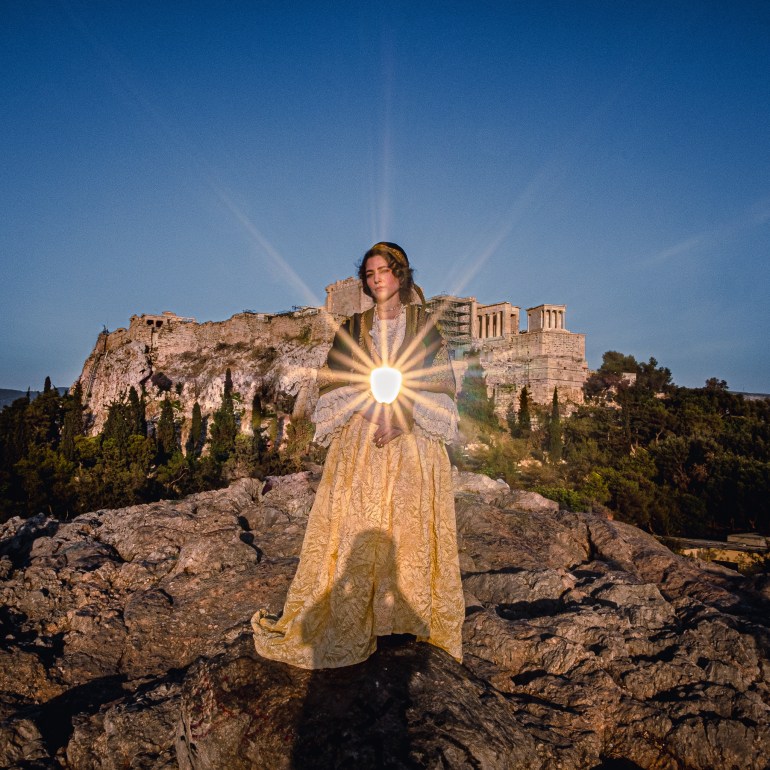
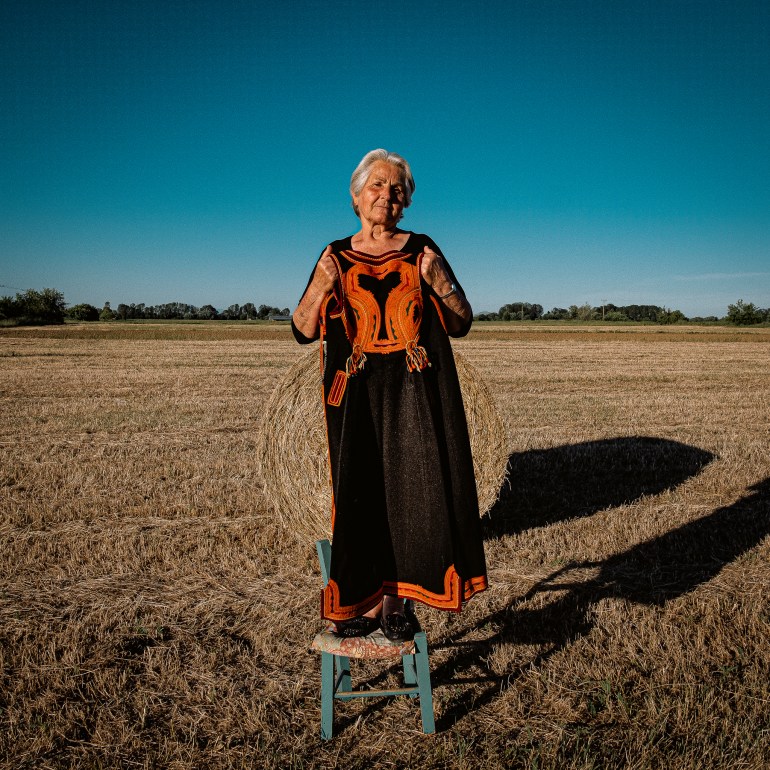
The medium-format portraits depict Pappas’ compatriots adorned in traditional garb and set against a diversity of eye-catching backdrops. Invariably characterized by rich colors, textures, and dexterous use of light, they possess a painting-like quality that befits the socio-historical subject matter and arrests and intrigues with striking immediacy.
Mitos, therefore, serves as a deeply arresting visual archive, and a tribute to Greece, whilst simultaneously, and with remarkable acuity, demonstrating the medium’s profound potential.


“You are truly blessing us with all these beautiful images!”
Xaviera Aubri
Contributing Fashion Editor
VOGUE Netherlands
Ici, ce n’est pas le costume qui fait la femme, c’est la femme qui sait le costume.
Nikos Aliagas
“Mitos, the ongoing series by Greek photographer Michael Pappas, is a compelling ethnographic tribute to the time-honored of his homeland”
THE INDEPENDENT PHOTOGRAPHER
“The medium-format portraits depict Michael Pappas’ compatriots adorned in traditional garb and set against a diversity of eye-catching backdrops.
Invariably characterized by rich colors, textures, and dexterous use of light, they possess a painting-like quality that befits the socio-historical subject matter and arrests and intrigues with striking immediacy.”
GREEK CITY TIMES
Mitos Project – Fine Art Photography Series
Photography is a way of keeping the thread of memory alive.
The Mitos Project is a visual narrative that connects tradition with contemporary identity, a dialogue between light, time, and memory.
Each work is realized as a limited edition fine art print,
printed on museum-grade archival paper,
hand-signed, numbered, and sealed with the official MITOS mark of authenticity,
as a guarantee of uniqueness and provenance.
Created for art collectors, galleries, and curators,
and for those who see in photography a way to preserve and reimagine the living thread of heritage.
📩 For inquiries or availability: info@pappasmichael.com
Part of an ongoing exploration of cultural identity through portraiture and tradition.
Print Information – Leica Q2
All photographs are captured with the Leica Q2, a full-frame camera with a 47.3-megapixel sensor, renowned for its exceptional detail, dynamic range, and clarity.
For square compositions (1:1 crop), the final image resolution is 5584 × 5584 pixels (approximately 31 megapixels), allowing for outstanding print quality in a wide range of sizes:
| Print Quality | Print Resolution (dpi) | Maximum Print Size | Recommended Use |
|---|---|---|---|
| Fine Art / Museum | 300 dpi | up to 50 × 50 cm | Ideal for fine art prints, exhibitions, and collector editions |
| Gallery | 240 dpi | up to 60 × 60 cm | Professional quality for gallery or limited edition prints |
| Large Format | 180 dpi | up to 80 × 80 cm | Suitable for interior decoration, viewed from short distance |
| Poster | 120 dpi | up to 120 × 120 cm | For large wall prints intended for viewing from a distance (>1m) |
Print quality remains exceptional even at larger sizes, thanks to the high-resolution sensor and the optical performance of the Leica Summilux 28mm f/1.7 ASPH lens.
SPOTLIGHT
PHOTOGRAPHER
VOGUE
‘QUALITY IN COLOR’

‘Νύφη του Γκέλβερι’
Ράφτηκε το 1925 στο Γκέλβερι της Καππαδοκίας.
Ένα νυφικό που ποτέ δεν φορέθηκε.
Σχεδόν, έναν αιώνα αργότερα, το φορά μια γυναίκα στη Νέα Καρβάλη, απόγονος εκείνων που έφυγαν από εκεί.
Μερικές νύφες δεν χάνονται.
Απλώς περιμένουν έναν αιώνα για να επιστρέψουν.
Νέα Καρβάλη, Ανατολική Μακεδονία και Θράκη, Ελλάδα. 2025.


A young woman wearing the traditional costume of her region. 2022.


The Guardians!
On the path that both unites and divides, where the Greek villages of Albania keep memory alive, two women stand as carriers of an unbroken continuity.
Tradition, land, identity – all woven together like a thread in the Mitos.
At this border, there are no real boundaries…only roots that continue to bloom.
ALBANIA. Dropull (Derapolis).
Two women from the Greek community of Northern Epirus, dressed in traditional local attire, standing along the borderland valley. 2024.

GREECE. Thessaly, Larisa. A woman from the Sarakatsani community of Thrace, dressed in her traditional costume. 2025.

‘The Gift’
In Greek tradition, the bride veils her face -the fabric separates her from the world, until another lifts it.
Only then is she revealed, only then does she belong.
In traditional Greek ritual, the veil held a very specific role and moment of revelation.
Before the wedding: the bride kept her face covered as a sign of purity, modesty, and obedience. The veil symbolized her transition from paternal to marital authority.
During the ceremony: the veil remained closed -the bride was present, yet unseen. She had not yet been “given away.”
After the wedding: the veil was lifted by the groom, either at the end of the ceremony or upon entering the home. This moment, called “revelation” or “illumination,” symbolized union, acceptance, and, symbolically, possession.
Essentially, the unveiling was an act of ownership and passage. Ιt was not performed by the woman herself, but upon her.
GREECE, Central Macedonia. Imathia. Agkathia village. A woman wearing her local costume. 2025.

GREECE. Central Macedonia, Imathia. Agkathia village. Women wearing their local traditional costume. 2025.

GREECE, Thessaly. Steafanovikeio village. A bride wearing her traditional wedding dress. 2022.

The Bride of Lazarus
Once, 80% of traditional garments in Greece were made at home, with techniques passed down through generations, stitched into memory and time. Today, handmade creation has almost fallen silent.
Only 5% of young people can still read the patterns and symbols of traditional embroidery.
A language fading away, along with our ability to listen to the quiet voices of history.
Deep down, we all search for roots, for continuity, for something that endures.
A single thread that ties us to what came before, holding us steady in the present.
GREECE, Central Macedonia. Imathia, Agkathia village. A woman wearing her local bridal costume. 2025.

‘The Union’
Once, the rider and the horse had to become one, not only to move together, but to survive.
Balance was a necessity, not a display, and through it were born respect, trust, and unity.
What we see here is not an act of performance, but a revelation of that ancient bond, the moment when human and horse become one body, as in the past, when survival depended on their union.
This image is part of the custom Momogeri, still performed today in Western Macedonia, Alonakia village, Kozani – a ritual where remnants of collective memory, myth, and movement intertwine.
A living echo of what once was necessity, now reborn as tradition.

The Thread is the belief that who we are has roots.
And that as long as someone remembers, nothing is ever truly lost.
Tradition is not something still or silent – it is a living organism, changing, breathing, reborn through those who hold it with love.
It is not a reenactment, but a continuation; a constant dialogue between light and memory.
Because, in the end, the only constant is change – and there, in the threshold between the old and the new, the Mitos is born.
GREECE. Central Macedonia, Imathia. Agkathia village. Young girls wearing their local traditional costumes, part of the Lazarines custom. 2025.


‘Woman of Lazarus’
GREECE. Central Macedonia, Imathia. Agkathia village. Young woman wearing her traditional costume. Part of the Lazarines custom. 2025.


‘Támata’
In our tradition, a tama is a promise, a gesture of faith and gratitude.
A small metal token carrying a great hope.
But not all támata are made of silver or copper.
Some are alive.
They are the people who hold the roots,
the children who wear the clothes of tradition,
those who continue, often without realizing it – an unbroken chain of generations.
These are the living offerings:
the carriers of memory, faith, and continuity.
They remind us that tradition is not something that belongs to the past,
but something that breathes within us every time we bring it back to life.
Because tradition is not a museum piece, it’s a living organism.
It changes, transforms, and adapts in order to survive.
And as long as there are people who carry it,
it will keep evolving – staying real, meaningful, and alive.
GREECE. Central Macedonia, Imathia. Agkathia village. Two young girls wearing the traditional attire. Part of the Lazarines custom. 2025.


GREECE. Central Macedonia, Imathia. Agkathia village. Woman wearing the traditional attire of the unmarried, known as the ‘The Uncrowned’. Part of the Lazarines custom. 2025.

GREECE. Central Macedonia, Imathia. Agkathia village. Women in traditional attire, part of the Lazarines custom. 2025.

GREECE. Central Macedonia, Imathia. Agkathia village. A bride wearing her traditional wedding dress. 2025.

‘The Talisman’
In Thessaly, the bride’s red veil is more than an ornament – it is a talisman.
The color of fire and blood, of fire and fertility.
Worn to ward off evil, to bless the new beginning, to protect the woman as she steps across the threshold of marriage.
Red as a pomegranate -symbol of abundance, fortune, and love that bears fruit.
A tradition still breathing, in the light and in the silence.


‘Bride of Gelveri’
A wedding dress, sawn in 1925 in Gelveri, Cappadocia.
A dress that was never worn.
Nearly a century later, it finds a voice and a body through a local woman in Nea Karvali.
No longer just fabric, but memory, patiently waiting to breathe again.
For her, it is a bridge back to her roots.
For us, a reminder that tradition does not vanish, it simply waits for its time to return.
Eastern Macedonia and Thrace, Nea Karvali. GREECE, 2025.
With the support of the Center for Cappadocian Studies ‘Nazianzos’ of Nea Karvali, and gratitude for the generous gift of the wedding dress, worn for the first time nearly a century after it was made.

GREECE. Thessaly, Larisa. Megalovryso village. Bride of Karagkounides community wearing her traditional wedding dress. 2024.

‘Bride of Gelveri’
A wedding dress from 1861.
A living piece of history from Gelveri, Cappadocia, before our eyes.
In this folds lie laughter, joy, dreams, but also tears and hidden anxieties of the woman who wore it back then.
The beginning of her life, woven into fabric.
And yet, today, the same dress adorns another woman.
A woman of the present, carrying her own soul, her own memories, her own dreams.
Two centuries apart, yet the same wedding dress becomes a bridge, connecting the past with the present, proving that traditions is not history.
It is a living presence that continues to thrive within us.
Eastern Macedonia and Thrace, Nea Karvali. GREECE, 2025.


The figures fade, the light remains.
Memories turn into threads that keep the place alive.


Roots the travel, hearts that endure.
Traditional costume from Karvali, Cappadocia, photographed in a refugee home in New karvali, Kavala.
Eastern Macedonia and Thrace, Sea Karvali, GREECE. 2025


“The memories that were lost do not fade – they become seeds of hope for what is yet to come.”


Tradition is never alone.
Continuity is that delicate line between “I am here” and “I was here.”
Thessaly, Larisa. Mega Monastère village. GREECE. 2025.


‘Bride of Kavakli’
A garment carrying within it memories of displacement, continuity, and identity.
Bridal attire of the refugees from Kavakli, Eastern Rumelia (Northern Thrace), late 19th century.
Traditional does not remain still, it breathes, transforms, and invites us to see it anew.

‘Ladies of Thasos’
Eastern Macedonia and Thrace, Thasos island. GREECE. 2025.

Home is not gust walls, it is roots, it is love, it is memory that rebuilds us again an again.
Eastern Macedonia and Thrace, Pangaion. GREECE. 2025.


At the foothills of Mount Pangaion, in the land of ancient Lydia, memory meets tradition.
A daughter stands in her ancestral home, wearing part of the local attire, a symbol of identity and roots.
The Mitos Project weaves once more the thread that connects us to the past, through images, stories, and lived experiences.
Because every costume, every stone of a house, every gaze carries within it the pulse of continuity.
Eastern Macedonia and Thrace, Pangaion. GREECE. 2025.

‘Bride of Gelveri’
A wedding dress from 1861.
A living piece of history from Gelveri, Cappadocia, before our eyes.
In this folds lie laughter, joy, dreams, but also tears and hidden anxieties of the woman who wore it back then.
The beginning of her life, woven into fabric.
And yet, today, the same dress adorns another woman.
A woman of the present, carrying her own soul, her own memories, her own dreams.
Two centuries apart, yet the same wedding dress becomes a bridge, connecting the past with the present, proving that traditions is not history.
It is a living presence that continues to thrive within us.
Eastern Macedonia and Thrace, Nea Karvali. GREECE, 2025.


‘Bride of Gelveri’
A wedding dress, sawn in 1925 in Gelveri, Cappadocia.
A dress that was never worn.
Nearly a century later, it finds a voice and a body through a local woman in Nea Karvali.
No longer just fabric, but memory – patiently waiting to breathe again.
For her, it is a bridge back to her roots.
For us, a reminder that tradition does not vanish, it simply waits for its time to return.
Eastern Macedonia and Thrace, Nea Karvali. GREECE, 2025.
With the support of the Center for Cappadocian Studies ‘Nazianzos’ of Nea Karvali, and gratitude for the generous gift of the wedding dress, worn for the first time nearly a century after it was made.


The past whispers.
The present listens.
Western Macedonia, Kozani. GREECE. 2023.


We celebrate the power of the image to reveal, to remind, and to tell stories.
Through the Mitos Project, photography becomes a thread that connects past and present, it gives presence to what risks being forgotten, bringing traditional costumes and the memories they carry back into the light.
From absence to presence, from silence to voice – the image becomes a bridge of culture.
This is what photography means to us.
This is Mitos Project.
Thessaly, Mégalo Monastère. GREECE. 2025.

This is not just a garment. It is history, memory, soul.
This 19th-century women’s costume from Skiathos was worn for the last time by a person for the sake of Mitos Project.
Fragile and irreplaceable, it could tear, it could fade – but through our lens, it comes alive again, bridging the past with the present.
Every thread tells a story, every fold holds a memory, and we have the honor of keeping it alive forever.
Skiathos island. GREECE. 2025.

Every tradition holds a piece of love, crafted by hands that passed it down through generations.
In the Mitos Project, beauty lies not just in colors or light, but in the way tradition meets innovation, preserving its essence.
Pause for a moment, and you might recall a story you thought was lost.
Peloponnese, Leonidio. GREECE. 2025.

BEST OF VOGUE


Hair the Wind Could Not Carry Away
Hair once combed in village courtyards, braided to the sound of songs, adorned for weddings, feasts, and mourning.
Hair that was not just beautiful, it became memory. It became a bond, a root, a silent prayer.
In Skiathos, twin sisters wear their grandmother’s traditional dress.
In the other image, her braids -Real hair, lovingly preserved, held like something sacred.
Because some hair cannot be taken by the wind.
It is held by memory.
Worn by the body.
Carried on through tradition.
Part of the Mitos Project, weaving stories of beauty, resilience, and identity.


A living tradition, woven in color.
The traditional costumes of Olympos village are more than clothing – they are memory, identity, celebration, and belief. Bold reds, deep blues, golden threads, and touches of black…every color tells a story: of joy and sorrow, fertility, protection, and reverence.
At this festival, a little girl wears her heritage with pride.
A thread connecting past and present.

The “Tsoukna” – A Draped Memory Woven in Wool.
In the village of Megalo Monastiri, women once wore the “tsoukna”: a pleated woolen overdress, rich in volume and heavier in meaning. It belongs to the broader costume tradition of Eastern Rumelia, and especially the Kavakli type.
Dark colors – deep blue, burgundy, black – met delicate embroidery: flowers, birds, and geometric borders stitched by hand. Beneath it, a cotton shirt with dyed sleeves (“phamsa”) and a vivid apron adorned with vertical geometric patterns (“pitsirka”) completed the look. Silk ribbons and woven details framed the hem with subtle opulence.
But this was more than clothing. It was a living archive, a garment infused with care, skill, and identity. Women spun and wove these pieces themselves, folding into every seam a part of who they were. Their hands traced memory into fabric.
Today, through the lens of Mitos Project, these heirloom garments return, not in nostalgia, but in recognition. A tribute to the grace and dignity of folk art, and to the thread of Greece that binds generations together.
GREECE. Thessaly. Megalo Monastiri. 2025.

GREECE. Thessaly, Magnesia. Women from Trikeri village, dressed in their region’s traditional costumes. 2025.


GREECE. Thessaly, Magnesia. A woman from Trikeri village, dressed in her region’s traditional costume. 2025.
BEST OF VOGUE

GREECE. Thessaly, Magnesia. 2025.
A woman from Trikeri village, dressed in her region’s traditional costume, stands inside the historic Church of the Holy Trinity (Agia Triada) in Trikeri, Magnesia.
This 18th-century three-aisled basilica is renowned for its magnificent frescoes and its intricately carved wooden iconostasis from 1739, considered one of the finest examples of ecclesiastical woodcarving.

BEST OF VOGUE
In collaboration with MANNA ARCADIA


‘From Body to Memory’

BEST OF VOGUE
In collaboration with MANNA ARCADIA

When Tradition Passes from Generation to Generation
Laid out on a white sheet, drying under the sun, two braids rest silently. At first glance, they may seem like simple hairpieces to a passerby. But they are not.
They carry weight, not from their material, but from years, embraces, celebrations, secrets, and care. These are braids once worn by women in their traditional dress, tucked under their headscarves, hanging proudly down their backs. And now, they bask in the light.
In many parts of Greece, the added braid is not a decoration of vanity; it is a symbol.
The woman of the village, of the community, wore her traditional garments with reverence. The braid that extended beyond her own hair was not just an aesthetic detail -it was part of her identity, the living continuation of the women before her.
In some homes, these braids have been carefully preserved for decades. Sometimes, they are passed on and worn again by a granddaughter. Other times, they are simply unwrapped, aired, honored.
It is remarkable how something so simple can carry so much memory.
Each strand, like a thread of family history, holds the scent of home, of a smoky kitchen, of Sunday celebrations, of weddings, and village festivals.

GREECE. Thessaly, Magnesia. Women from Trikeri village, dressed in their region’s traditional costumes. 2025.
BEST OF VOGUE

GREECE. Thessaly, Magnesia. Women from Trikeri village, dressed in their region’s traditional costumes. 2025.
BEST OF VOGUE

GREECE. Thessaly, Magnesia. A woman from Trikeri village, dressed in her region’s traditional costume. 2025.
BEST OF VOGUE


GREECE. Thessaly, Larisa. A woman from Megalo Monastiri, dressed in her region’s traditional costume. 2025.
BEST OF VOGUE

BEST OF VOGUE

BEST OF VOGUE


BEST OF VOGUE

BEST OF VOGUE

BEST OF VOGUE


BEST OF VOGUE

GREECE. Thessaly, Larisa. A woman from Megalo Monastiri, dressed in her region’s traditional costume. 2025.
BEST OF VOGUE

BEST OF VOGUE

GREECE. Thessaly, Larisa. A woman from Megalo Monastiri, dressed in her region’s traditional costume. 2025.
BEST OF VOGUE

GREECE. Ionian Sea. A woman from South Corfu dressed in her traditional local wedding dress. 2025.
BEST OF VOGUE

The traditional urban dress and bridal attire brought by the refugees of Tenedos in 1923
reflect the rich cultural heritage of this small yet historically significant island.
BEST OF VOGUE

BEST OF VOGUE

BEST OF VOGUE

GREECE. Thessaly, Trikala. A girl from Aspropotamos dressed in her traditional local costume. 2024.
BEST OF VOGUE

BEST OF VOGUE

PIC OF THE DAY on VOGUE

GREECE. Eastern Macedonia and Thrace, Rhodope. A woman from the Armenian community of Komotini dressed in her traditional costume. 2024.
BEST OF VOGUE

BEST OF VOGUE

BEST OF VOGUE

GREECE. Thessaly. Bride of Anatoli village in local wedding dress. 2024.
BEST OF VOGUE

BEST OF VOGUE

BEST OF VOGUE

BEST OF VOGUE

GREECE. Thebes. Bride of Boeotia in local wedding dress. 2021.
BEST OF VOGUE


BEST OF VOGUE

BEST OF VOGUE

GREECE. Aegean Sea. Dodecanese. Karpathos island. Avlona village. Lady of Olympos village in local costume. 2024.
BEST OF VOGUE


GREECE. Aegean Sea. Dodecanese. Karpathos island. Avlona village. Lady of Olympos village in local costume worn by unmarried women. 2024.
BEST OF VOGUE

BEST OF VOGUE

BEST OF VOGUE

Bride of Deropoli in local wedding dress of Greek village Georgoutsates.
2024.

Bride of Deropoli in local wedding dress of Greek village Dervicani.
2024
BEST OF VOGUE

Bride of Deropoli in local wedding dress of Greek village Georgoutsates.
2024
BEST OF VOGUE

Erini – Malés
“ALL OF GREECE ONE CULTURE”
2024 by the Ministry of Culture
BEST OF VOGUE

BEST OF VOGUE

GREECE. Central Macedonia. Emathia. Bride of Agkathia village in local wedding dress. 2023.

GREECE. Thessaly. Karditsa. Lady of Palamas village in local costume. 2024.
BEST OF VOGUE

BEST OF VOGUE

GREECE. Aetolia-Acarnania. Bride of Palaiomanina village in local wedding dress. 2024.
BEST OF VOGUE

GREECE. Aetolia-Acarnania. Bride of Palaiomanina village in local wedding dress. 2024.
BEST OF VOGUE

BEST OF VOGUE

GREECE. Epirus. Ioannina. North Tzoumerka. Bride of Kallarytes village in local wedding dress. 2019.
BEST OF VOGUE

BEST OF VOGUE

BEST OF VOGUE

BEST OF VOGUE


BEST OF VOGUE

GREECE. Aegean Sea. Bride of Skopelos island in local wedding dress. 2024.
BEST OF VOGUE

BEST OF VOGUE

BEST OF VOGUE

BEST OF VOGUE

GREECE. Thessaly. Larisa. Megalovryso village. Bride in the local wedding dress and ladies in the local costumes. 2024.
BEST OF VOGUE

GREECE. Thessaly. Bride of Anatoli Agias in the local wedding dress. 2024.

BEST OF VOGUE

GREECE. Thessaly. Bride and Ladies of Anatoli Agias in the local wedding dress and the local costumes. 2024.
VOGUE

BEST OF VOGUE

GREECE. Thessaly. Bride and Ladies of Trikeri in the local wedding dress and the local costumes. 2024.
BEST OF VOGUE

Memory Trek in Eastern Thrace.
TURKEY. Kirklareli. 2023.
In collaboration with Ethnological Museum of Thrace.
BEST OF VOGUE

BEST OF VOGUE

BEST OF VOGUE

The authentic attire of Queen Amalia of Greece, photographed at the First Palace and Royal residence of the State, known nowadays as “Museum of the city of Athens” – Vouros Eutaxias Foundation. 2023.
BEST OF VOGUE

The authentic attire of Queen Amalia of Greece, photographed at the First Palace and Royal residence of the State, known nowadays as “Museum of the city of Athens” – Vouros Eutaxias Foundation. 2023.
BEST OF VOGUE

BEST OF VOGUE

BEST OF VOGUE

TURKEY. Kirklareli. 2023.
ΤΟΥΡΚΙΑ. Σαράντα Εκκλησιές. 2023.
In collaboration with Ethnological Museum of Thrace.
BEST OF VOGUE

TURKEY. Edirne. 2023.
ΤΟΥΡΚΙΑ. Αδριανούπολη. 2023.
In collaboration with Ethnological Museum of Thrace.
BEST OF VOGUE

BEST OF VOGUE


GREECE. Aegean Sea. Northern Sporades. Bride of Skopelos island in the local wedding dress. 2023.


Very early in the morning the participants in the ritual wearing traditional costumes and bearing poles adorned with flowers and wild celery walk to the outlying church of Aiyioris, situated at spot elevation 1280 meters above sea levels, on a steep rock that dominates the landscape.
GREECE. Peloponnese. Arcadia. Nestani. April 23, 2023.
Mitos/ The Thread of Greece.


GREECE. Thessaly. Bride of Trikeri in local wedding dress. 2021.


Grandmother, great-granddaughter and granddaughters at home, all in their local costumes. 2023.






BEST OF VOGUE

BEST OF VOGUE

BEST OF VOGUE
